CCNA (Cisco Certified Network Associate)
Build a strong foundation in computer networking with our CCNA course. CCNA validates a broad range of fundamentals for all IT careers from networking technologies, to security, to software development proving you have the skills businesses need to meet market demands.
Our Objectives
What we aim to achieve through this training
Understand networking fundamentals and network protocols.
Learn IPv4, IPv6 and subnetting.
Configure routers, switches and VLANs.
Understand routing protocols, including OSPF.
Implement basic network security and access control.
Configure essential network services such as DHCP, DNS and NAT.
Gain hands-on experience with Cisco networking devices and Packet Tracer.
Prepare for the Cisco 200-301 CCNA certification exam.
What You'll Learn?
Gain practical, job-ready skills to excel in this field
Switch and End-Device Configuration
Configure switches and end devices to access local and remote network resources.
Ethernet and Network Protocols
Understand how physical and data link layer protocols support Ethernet communication in switched networks.
Router Configuration
Configure routers to establish end-to-end connectivity between devices across different networks.
IPv4 and IPv6 Addressing
Design IPv4 and IPv6 addressing schemes and verify connectivity between network devices.
Network Applications and OSI Model
Understand how the upper layers of the OSI model support network applications and communication.
Network Security
Configure small networks using security best practices and basic access control measures.
Network Troubleshooting
Identify, diagnose and resolve common connectivity issues in small networks.
Course Curriculum
Structured learning path to master CCNA (Cisco Certified Network Associate)
Network Fundamentals
Learn networking concepts, network devices, OSI and TCP/IP models, IPv4 and IPv6 addressing, subnetting, transport protocols, wireless principles and network virtualization.
- Explain the role and function of network components
- Describe characteristics of network topology architectures
- Compare physical interface and cabling types
- Identify interface and cable issues (collisions, errors, mismatch duplex and/or speed)
- Compare TCP to UDP
- Configure and verify IPv4 addressing and subnetting
- Describe private IPv4 addressing
- Configure and verify IPv6 addressing and prefix
- Describe IPv6 address types
- Verify IP parameters for Client OS (Windows, Mac OS, Linux)
- Describe wireless principles
- Explain virtualization fundamentals (server virtualization, containers and VRFs)
- Describe switching concepts
Network Access
Understand VLANs, trunking, inter-VLAN connectivity, EtherChannel, Spanning Tree Protocol, CDP, LLDP and wireless LAN architectures and configuration.
- Configure and verify VLANs (normal range) spanning multiple switches
- Configure and verify interswitch connectivity
- Configure and verify Layer 2 discovery protocols (Cisco Discovery Protocol and LLDP)
- Configure and verify (Layer 2/Layer 3) EtherChannel (LACP)
- Interpret basic operations of Rapid PVST+ Spanning Tree Protocol
- Describe Cisco Wireless Architectures and AP modes
- Describe physical infrastructure connections of WLAN components (AP, WLC, access/trunk ports and LAG)
- Describe network device management access (Telnet, SSH, HTTP, HTTPS, console, TACACS+/RADIUS and cloud managed)
- Interpret the wireless LAN GUI configuration for client connectivity, such as WLAN creation, security settings, QoS profiles and advanced settings
IP Connectivity
Learn routing table interpretation, packet forwarding, static routing, default routes, floating static routes, OSPF configuration and first-hop redundancy concepts.
- Interpret the components of routing table
- Determine how a router makes a forwarding decision by default
- Configure and verify IPv4 and IPv6 static routing
- Configure and verify single area OSPFv2
- Describe the purpose, functions and concepts of first hop redundancy protocols
IP Services
Explore NAT, DHCP, DNS, NTP, SNMP, syslog, QoS, SSH, DHCP relay and FTP/TFTP services used in modern networks.
- Configure and verify inside source NAT using static and pools
- Configure and verify NTP operating in a client and server mode
- Explain the role of DHCP and DNS within the network
- Explain the function of SNMP in network operations
- Describe the use of syslog features including facilities and levels
- Configure and verify DHCP client and relay
- Explain the forwarding per-hop behavior (PHB) for QoS, such as classification, marking, queuing, congestion, policing and shaping
- Configure network devices for remote access using SSH
- Describe the capabilities and functions of TFTP/FTP in the network
Security Fundamentals
Understand network security threats, access control lists, device security, authentication and authorization, VPNs, port security, DHCP snooping and wireless security.
- Define key security concepts (threats, vulnerabilities, exploits and mitigation techniques)
- Describe security program elements (user awareness, training and physical access control)
- Configure and verify device access control using local passwords
- Describe security password policies elements, such as management, complexity and password alternatives (multifactor authentication, certificates and biometrics)
- Describe IPsec remote access and site-to-site VPNs
- Configure and verify access control lists
- Configure and verify Layer 2 security features (DHCP snooping, dynamic ARP inspection and port security)
- Compare authentication, authorization and accounting concepts
- Describe wireless security protocols (WPA, WPA2 and WPA3)
- Configure and verify WLAN within the GUI using WPA2 PSK
Automation and Programmability
Explore network automation, controller-based networking, software-defined networking, REST APIs, JSON data formats, AI and machine learning concepts and configuration management tools.
- Explain how automation impacts network management
- Compare traditional networks with controller-based networking
- Describe controller-based, software defined architecture (overlay, underlay and fabric)
- Explain AI (generative and predictive) and machine learning in network operations
- Describe characteristics of REST-based APIs (authentication types, CRUD, HTTP verbs and data encoding)
- Recognize the capabilities of configuration management mechanisms, such as Ansible and Terraform
- Recognize components of JSON-encoded data
Key Features
Industry-Aligned Curriculum
Learn networking concepts aligned with the Cisco CCNA 200-301 certification exam objectives.
Hands-On Practical Labs
Gain practical experience configuring routers, switches, VLANs and routing protocols through network simulations.
Beginner-Friendly Training
Start with networking fundamentals and progress step by step to routing, switching and network security.
Cisco Packet Tracer Practice
Build and simulate network topologies to develop configuration and troubleshooting skills.
Real-World Scenarios
Practice solving common networking problems and learn how networks operate in real business environments.
Exam Preparation
Strengthen your knowledge with practice questions, revision sessions and CCNA exam-focused exercises.
Network Troubleshooting Skills
Learn to identify connectivity issues, analyze network configurations and resolve common network faults.
Career-Focused Learning
Develop foundational networking skills for entry-level roles in network support, IT operations and network engineering.
Certification & Exam Details
| Exam Name | Cisco Certified Network Associate (CCNA) |
| Exam Code | 200-301 CCNA |
| Exam Duration | 120 minutes |
| Number and type of Questions | Expect a variety of formats, including performance-based questions, multiple choice and drag-and-drop |
| Results | Pass/fail results are typically available online within 48 hours |
| Language of Exam | English |
Why Choose Edura for an Online Course?
Empowering your career with globally recognized excellence.
Edura partners with global certification bodies (like PostgreSQL, Microsoft, ICAEW, etc.) to deliver industry‑aligned courses.
Our courses are designed around real-world industry requirements, ensuring learners gain relevant and up-to-date skills that create meaningful career opportunities.
Learn from experienced instructors who bring practical industry insights, technical expertise and proven methodologies into every session.
Our programs are structured to help professionals enhance their capabilities, achieve certifications and progress confidently in their careers.
Experience learning beyond theory through interactive sessions, real-world scenarios, hands-on labs and practical assignments that build workplace confidence.
Options include classroom, online and blended formats, making it accessible for working professionals and students.
Who Can Join?
Designed for anyone starting their learning journey
Students & Fresh Graduates
Ideal for students and graduates who want to build networking skills and start a career in IT.
Beginners
Suitable for individuals with basic computer knowledge who want to learn networking from scratch.
IT Support Professionals
Perfect for IT support technicians who want to strengthen their networking knowledge and advance their careers.
Aspiring Network Engineers
Designed for individuals who want to learn routing, switching, network configuration and troubleshooting.
System Administrators
Helps system administrators expand their networking skills and better manage network infrastructure.
Career Changers
Suitable for professionals looking to transition into networking, network administration or network operations roles.
Career Paths
Roles and opportunities following this course
Entry Level / Foundation Roles
Network Support Technician, IT Support Engineer, NOC Engineer.
Mid Level / Specialised Roles
Network Engineer, Network Administrator, Network Security Engineer.
Advanced / Leadership Roles
Senior Network Engineer, Network Architect, Network Operations Manager.
How To Get Certified?
Register at Edura Training and Development
Complete the recommended training modules
Pass the final assessment
Earn your CCNA Certification
Frequently Asked Questions
The CCNA certification is designed for entry-to-mid-level IT professionals who want to specialize in networking, security or automation. If you’re aspiring to become a network engineer, administrator or technician and want to validate your skills in installing, configuring and troubleshooting Cisco-based, enterprise-level network infrastructures, this certification is for you.
The CCNA certification certifies you to work with the Cisco products like Cisco routers, switches, wireless LAN controllers and network management platforms, like Cisco DNA Center and Cisco SD-WAN.
The CCNA certification is designed as a starting point and assumes you have little to no networking knowledge. It covers a broad range of topics, including traditional routing and switching, wireless, security fundamentals and an introduction to automation and programmability.
The CCNA certification is not equivalent to an academic degree. It is a professional credential that is highly valued in the industry, but it does not replace the educational requirements of a degree program.
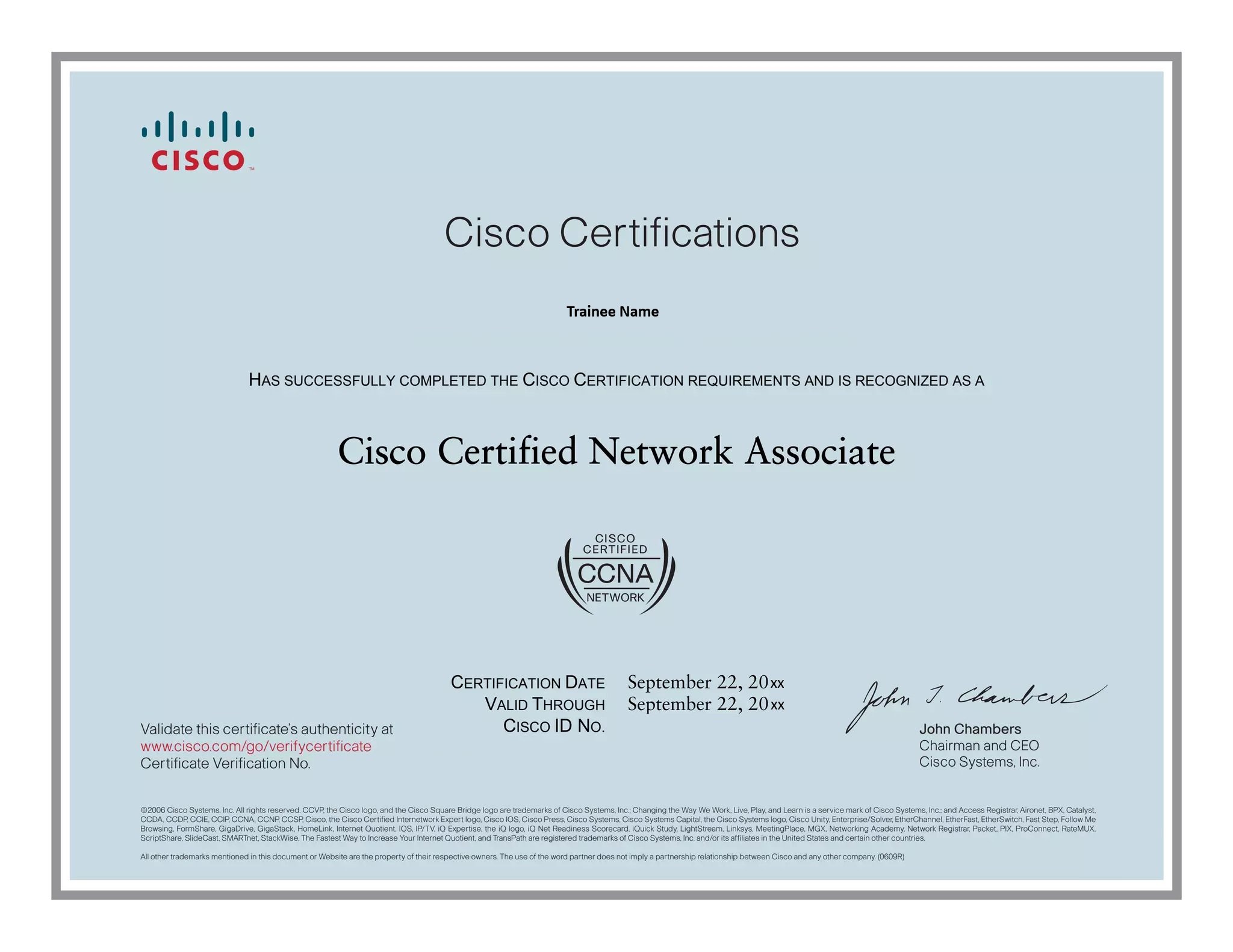
When you pass the CCNA exam, you earn the CCNA certification, a globally recognized credential that validates your networking knowledge and skills.
The exam is 120 minutes long, offered in English and Japanese and graded on a pass/fail basis. Results are typically available online within 48 hours.